
With a neat sketch explain the functions of the main components of a HAWT.
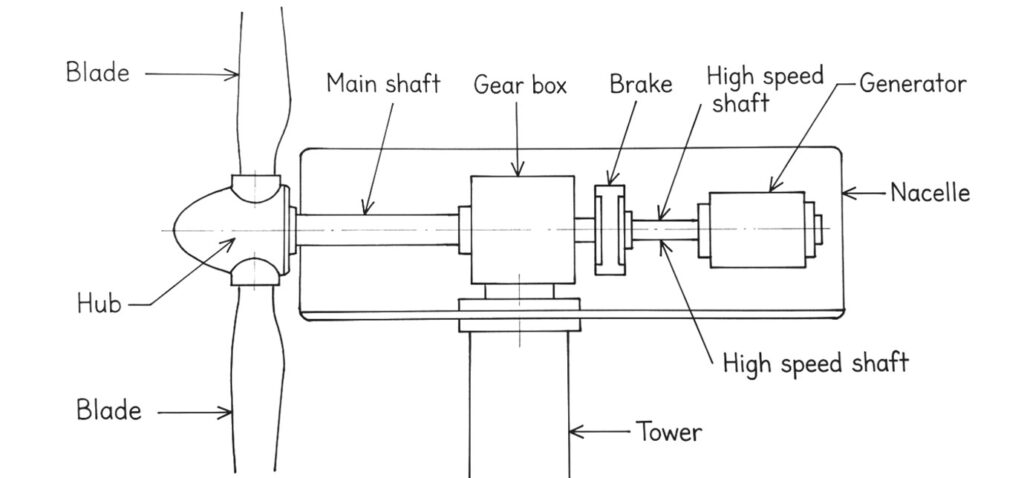
Functions of Main Components of a HAWT
- Tower: Supports the turbine and places it at a higher height to access stronger winds.
- Rotor (Blades & Hub): Captures wind energy and converts it into rotational motion.
- Pitch Mechanism: Adjusts blade angle to control power and protect the turbine in high winds.
- Nacelle: Encloses key parts like gearbox, generator, and control system.
- Drive Shaft & Gearbox: Transfer and increase rotational speed from rotor to generator.
- Generator: Converts mechanical energy into electrical energy.
- Yaw System: Rotates the turbine to face the wind direction.
- Brake & Sensors: Brake stops the turbine; sensors measure wind speed and direction.
- Controller: Controls overall operation for safety and efficiency.
Detailed Explanation of Horizontal Axis Wind Turbine (HAWT) Components:
Think of a Horizontal Axis Wind Turbine (HAWT) as a massive, high-tech windmill designed for the 21st century. It’s not just a set of spinning blades; it’s a sophisticated machine where every part has a specific job to turn a simple breeze into the electricity that powers our homes.
Here is a look at what’s happening inside:
1. The Tower: Reaching for the Sky
Everything starts with the tower. Standing anywhere between 50 and 120 meters tall, this steel or concrete structure is not just a support—it is a strategic choice. The higher the turbine sits, the stronger and smoother the winds it can access. Ground-level winds are often weak and inconsistent, so height makes a real difference in how much energy a turbine can generate.
2. The Rotor (Blades and Hub)
The rotor is the most recognizable part of any wind turbine. It consists of long, curved blades attached to a central hub. As wind flows over the specially shaped blades, it creates a lift force — the same principle that allows aircraft wings to fly — and this causes the entire rotor to spin. The hub holds the blades in place and passes that rotational energy into the turbine.
3. Pitch Mechanism: The Safety Switch
Wind does not always blow at the perfect speed, so the blades need to be smart about how they position themselves. The pitch mechanism adjusts the angle of each blade depending on wind conditions. When winds are gentle, the blades tilt to catch as much energy as possible. When winds become dangerously strong, the blades rotate to a safer angle to protect the turbine from damage.
4. The Nacelle: The Engine Room
Perched right at the top of the tower, the nacelle looks like a large capsule from the outside. Inside, it houses the most important mechanical and electrical components of the turbine. Think of it as the engine room — compact, well-protected, and absolutely essential.
5. Drive Shafts and Gearbox: The Speed Booster
The rotor spins slowly, which is fine for capturing wind energy but not fast enough to generate electricity efficiently. This is where the drivetrain comes in. A low-speed shaft carries the rotor’s rotation into a gearbox, which dramatically increases the speed — sometimes by a ratio of 1:90. The resulting high-speed rotation is then passed on to the generator.
6. The Generator: Generating Electricity
The generator is where the magic happens. As the high-speed shaft spins inside it, electromagnetic induction converts that mechanical movement into alternating current electricity. This power then travels down the tower and into the electrical grid, ready to power homes, schools, and businesses.
7. Yaw System: Finding the Wind
Wind rarely blows from exactly the same direction all day. The yaw system solves this by rotating the entire nacelle left or right so the rotor always stays pointed into the wind. Without it, the turbine would lose a significant amount of potential energy every time the wind shifted direction.
8. Sensors and Brakes: The Safety Net
Safety is built into every part of a wind turbine. The brake system can bring the rotor to a complete stop whenever maintenance is needed or conditions become too extreme.
Meanwhile, sensors keep a constant watch on what is happening outside — an anemometer measures how fast the wind is blowing, and a wind vane tracks which direction it is coming from. This data feeds directly into the control system.
9. The Controller: The Brain
The controller is the onboard computer that runs the show. It constantly reads data from the sensors and automatically decides when to tilt the blades, turn the nacelle, or hit the brakes to keep everything running safely and efficiently.