
A controlling device is used in an indicating electrical instrument to produce a controlling torque. This torque opposes the deflecting torque and brings the pointer to a definite position.
The two common controlling devices are spring control and gravity control.
1. Spring Control
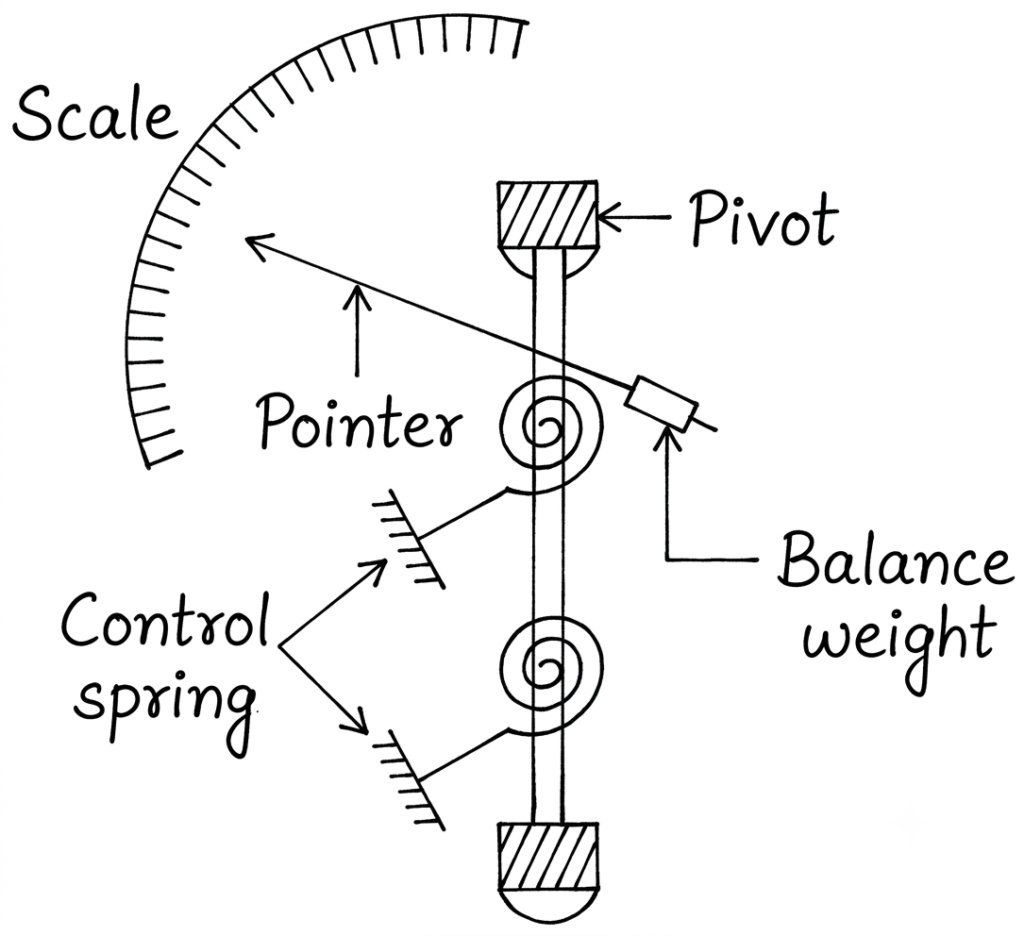
A phosphor-bronze spiral spring is attached to the spindle of the moving system. As the pointer deflects through angle θ, the spring winds or unwinds and develops a restoring torque directly proportional to the deflection:
Tc = K·θ
where K is the spring constant, dependent on the material and dimensions of the spring.
Two springs, coiled in opposite directions, are generally used so that one unwinds while the other winds; this smooths the control action, compensates for thermal expansion, and in PMMC instruments also serves to lead current into the moving coil.
Characteristics
- Scale is uniform, since controlling torque is directly proportional to deflection.
- Instrument may be mounted in any position, as the control action is independent of gravity.
- Spring elasticity may vary with temperature, introducing a small error.
2. Gravity Control
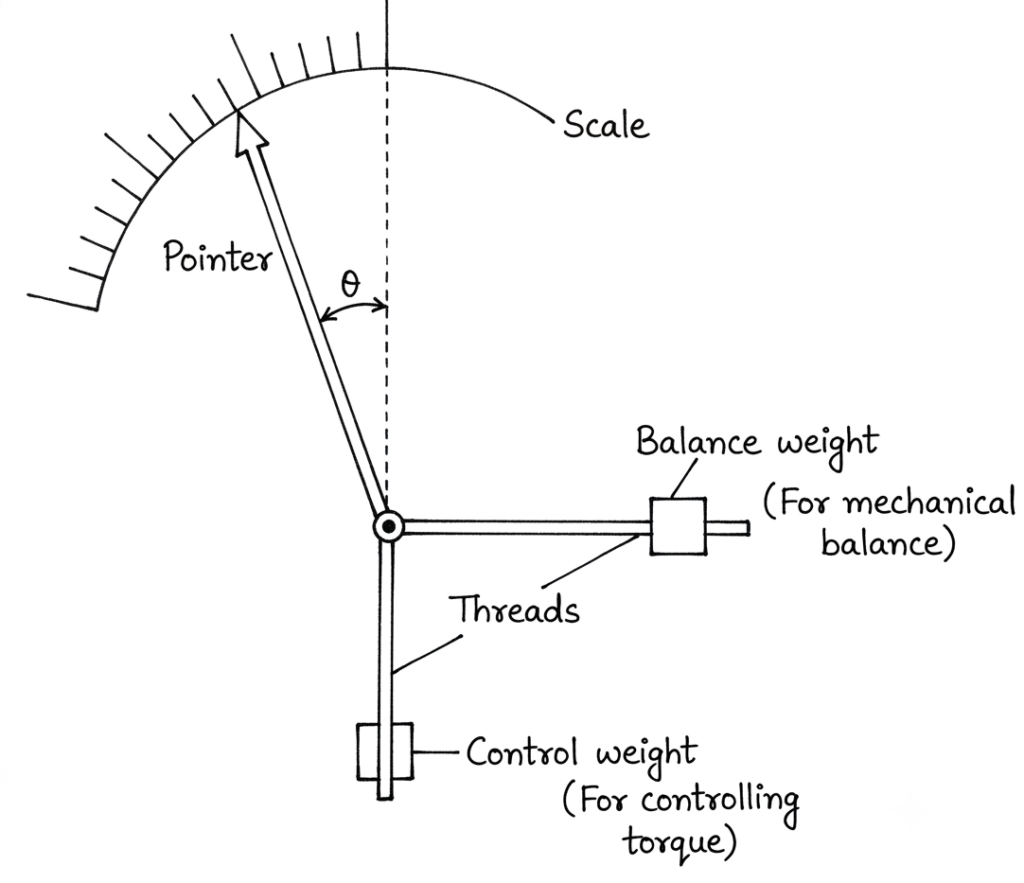
A small adjustable control weight is mounted on an arm fixed to the moving system; a separate balance weight offsets the system’s own weight. As the system deflects through angle θ, the control weight moves away from the vertical and produces a restoring torque:
Tc = W·l·sin θ
where W is the control weight and l is its distance from the spindle axis.
Characteristics
- Scale is non-uniform and appears cramped near the zero mark.
- Instrument must be mounted strictly vertical for accurate operation, since the method relies on gravity.
- Construction is simple and inexpensive, and performance is unaffected by temperature.
Difference between Spring control and Gravity control
| Parameter | Spring Control | Gravity Control |
| Governing Relation | $$T_c \propto \theta$$ | $$T_c \propto \sin\theta$$ |
| Scale Nature | Uniform (if $$T_d \propto I$$) | Non-uniform / cramped at bottom |
| Operating Position | Any orientation | Vertical only |
| Temperature Effect | Affected (spring stiffness changes) | Unaffected |
| Aging & Fatigue | Deteriorates over time | Free from aging effects |
| Application | Precision & portable instruments | Cheap, stationary panel meters |
Which type of controlling device—spring control or gravity control—is preferred for portable instruments, and why?
Spring control is preferred for portable instruments because its controlling torque is independent of the instrument’s position.
In contrast, gravity control is affected by the position of the instrument.