
Definition:
The resistor is a passive electrical component that creates resistance in the flow of electric
current.
Resistor is a passive component.
What is Resistance?
It is the property of a material that opposes the flow of electric current through it.
SI Unit of Resistance:
It is measured in Ohms(Ω) and denoted by ‘R’.
Symbols:
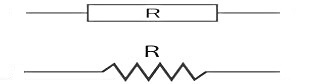
Types of Resistor:
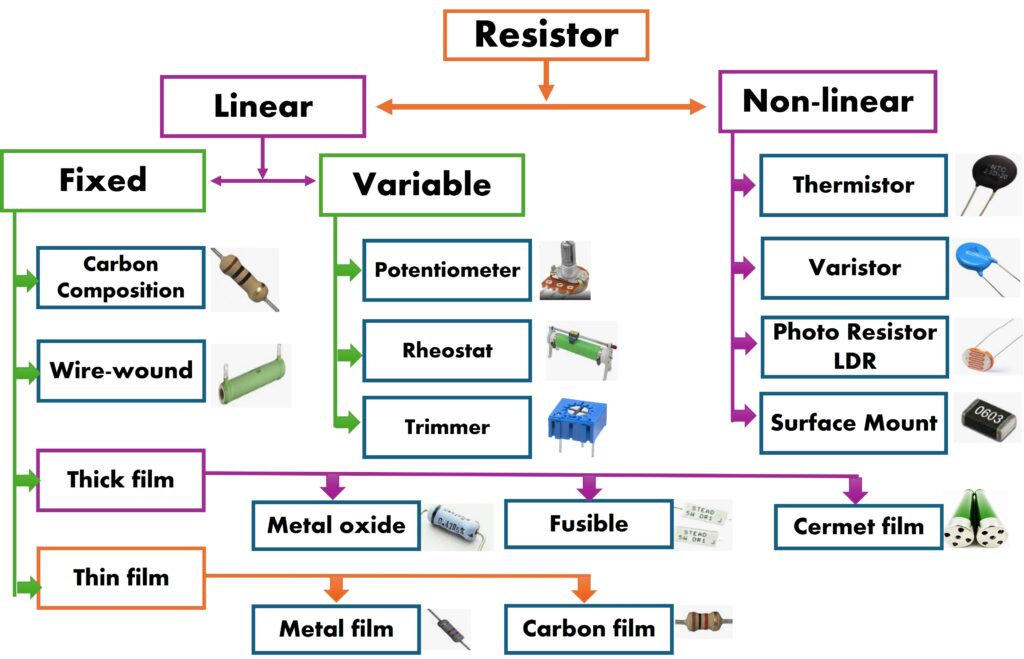
Linear resistance:
Linear resistance refers to the behaviour of a resistor whose resistance remains constant regardless of the current flowing through it and whose characteristics remain constant when variables like voltage and temperature change.
Fixed Resistor:
A fixed resistor is one whose resistance value is set and cannot be changed or varied under normal operation.
Examples: Carbon Composition Resistor, Metal Oxide Resistor, Wire-Wound resistor, etc.
Variable Resistor:
A variable resistor is a resistor whose resistance value can be adjusted manually, allowing it to vary within a specific range.
Examples: Potentiometer, Rheostat, Trimmer, etc.
Non-linear resistance:
A nonlinear resistor is one that does not obey Ohm’s law. The non-linear resistor’s I-V characteristic is not a straight line.
Whose characteristics can be changed when variables like voltage and temperature change.
Applications of Resistors:
- Current Limiting: Protects components (e.g., LEDs) by restricting current flow.
- Voltage Division: Divides voltage into smaller values for sensors or circuits.
- Temperature Sensing: Used in thermistors to detect temperature changes.
- Biasing Transistors: Sets operating point in amplifiers and oscillators.
- Power Dissipation: Converts electrical energy into heat, protecting components.
- Surge Protection: Limits current surge to protect components.
- Timing Circuits: Controls timing in RC circuits for delays or oscillations.
- LED Brightness Control: Vary brightness by adjusting current with a potentiometer and many more.
FAQs on Resistor
Q1. What is the main function of a resistor?
The main function of a resistor is to limit or control the current and divide voltage in a circuit.
Q2. What are the types of resistors?
Common types of resistors are:
- Fixed Resistor
- Variable Resistor (Potentiometer)
- Thermistor
- LDR (Light Dependent Resistor)
Q3. What is the unit of resistance?
The unit of resistance is the Ohm (Ω).
Q4. Where is a resistor used?
Resistors are used in LED circuits, voltage dividers, amplifiers, and power supply circuits.
Q5. What happens if a resistor is not used?
If a resistor is not used where needed, too much current may flow and damage components like LEDs or transistors.
Q6. What is Ohm’s Law related to resistor?
Ohm’s Law states that Voltage (V) = Current (I) × Resistance (R). It helps to calculate how much current will flow through a resistor.
Q7. Can a resistor store energy?
No, a resistor does not store energy. It only converts electrical energy into heat when current passes through it.
Q8. Why do we use resistors in LED circuits?
We use resistors in LED circuits to control the current flow and prevent the LED from burning.