
Solar radiation geometry explains how the Sun’s position changes relative to the Earth and a receiving surface like a solar panel. Understanding these angles and terms is essential for solar energy system design, panel orientation, and radiation calculation. In this guide, we explain the core terms in a simple, exam-ready and human-friendly way.
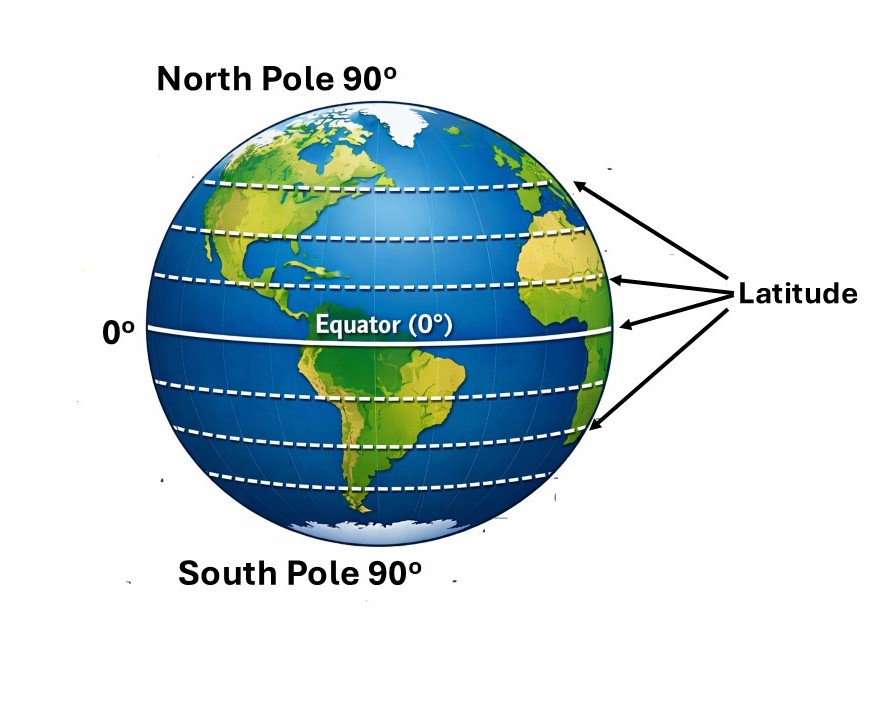
Latitude
Latitude is the angular position of a place measured north or south of the equator.
- It is expressed in degrees from 0° to 90°.
- Latitude strongly affects how much solar radiation a location receives because it controls the Sun’s apparent height in the sky throughout the year. Places closer to the equator generally receive more consistent sunlight.
Longitude
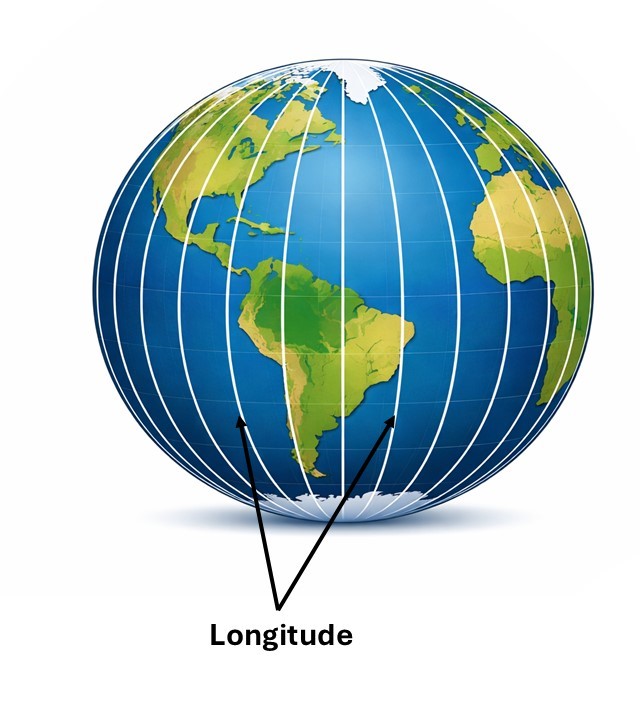
Longitude is the angular distance of a place measured east or west of the Prime Meridian.
- It is measured from 0° to 180°.
- Longitude mainly affects the local solar time and is used when converting clock time into solar time for solar calculations.
Declination Angle (δ)
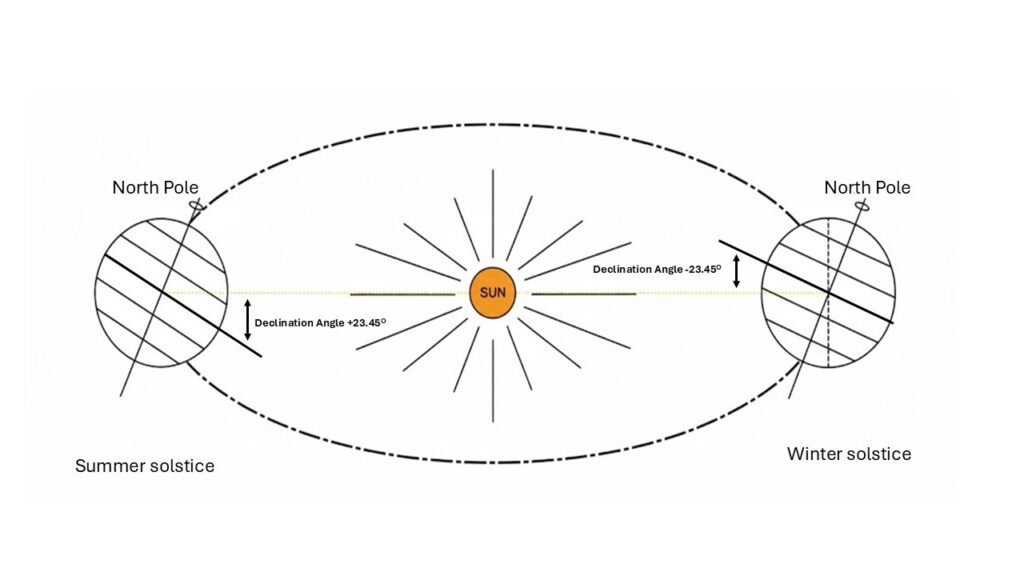
Declination angle is the angle between the Sun’s rays and the Earth’s equatorial plane.
- It changes daily due to the tilt of the Earth’s axis and its revolution around the Sun. The value varies between +23.45° and −23.45° during the year.
- This angle explains why we have seasons and changing day lengths.
Zenith Angle (θz)
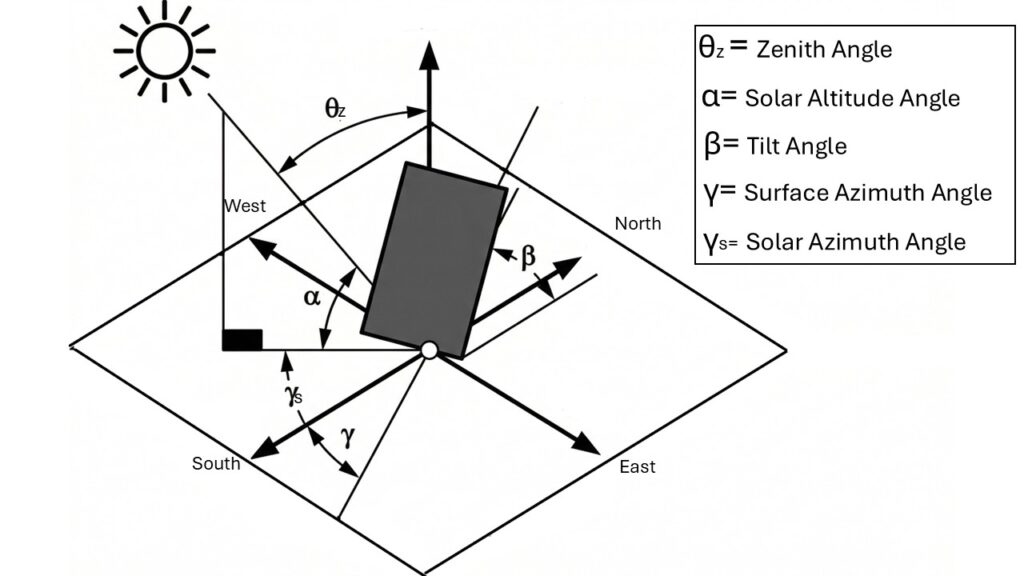
The Zenith Angle (θz) is the angle between the Sun’s rays and the vertical line directly above an observer, known as the zenith.
- It indicates how far the Sun is from the overhead position.
- When the Sun is directly overhead, the zenith angle is 0°.
- When the Sun is near the horizon, the zenith angle is close to 90°.
- The zenith angle and the solar elevation angle are complementary. Their sum equals 90°.
- The zenith angle is important for calculating solar radiation intensity and determining the angle of incidence on a surface.
Surface Azimuth Angle (𝛾)
The Surface Azimuth Angle is the horizontal angle between the normal (perpendicular) to the surface and True South (or True North depending on convention).
- Surface azimuth angle describes the compass direction that a surface or solar panel is facing.
- A south-facing surface has 0°, east-facing is negative, and west-facing is positive. Correct azimuth improves solar energy capture.
- Solar azimuth angle gives the horizontal direction of the Sun at a specific time. It tells where the Sun is located along the horizon line. This angle is important for tracking systems and shadow analysis.
Solar Azimuth Angle (𝛾s)
The Solar Azimuth Angle is the horizontal angle between the projection of the Sun’s rays on the ground and the reference direction (usually True North or True South, depending on convention).
- Solar azimuth angle describes the compass direction of the Sun at a particular moment. It tells where the Sun is positioned along the horizon.
- In the Northern Hemisphere (when measured from True South):
- When the Sun is exactly south – 0°
- When the Sun moves toward the west – positive
- When the Sun moves toward the east – negative
- Since the Sun continuously moves across the sky, the solar azimuth angle changes throughout the day.
- Used in solar tracking, shadow analysis, and solar energy calculations.
Slope of Surface or Tilt Angle (β)
Slope or tilt angle is the angle between a surface and the horizontal ground.
- A flat surface has 0° tilt, while a vertical wall has 90°.
- Choosing the correct tilt angle helps maximize yearly solar energy output.
Hour Angle (ω)
Hour angle represents how far the Sun has moved from solar noon. It changes at 15° per hour.
Before solar noon it is negative, after solar noon it is positive, and at solar noon it is zero. It directly connects solar geometry with time of day.
Angle of Incidence (θ)
The angle of incidence is the angle between the incoming Sun rays and the perpendicular (normal) to the surface.
When this angle is small, more solar energy is absorbed. When it is large, less energy is received. Solar system design aims to keep this angle as low as possible.