
A solar map of India shows how much sunlight energy different regions receive throughout the year. This energy is called solar radiation and it is the base of solar power generation. Engineers and students use these maps to understand where solar plants will perform better.
What is Solar Radiation?
Solar radiation is the energy that comes from the sun in the form of electromagnetic waves. When this energy reaches the earth’s surface, it can be measured and used to produce electricity using solar panels.
Common Units Used
- kWh/m²/day
- kWh/m²/year
On solar maps, colors are used to show intensity:
- Dark / warm colours – higher solar energy
- Light / cool colours – lower solar energy
Solar Radiation Types
Solar radiation is mainly divided into three parts:
- Beam radiation
- Diffuse radiation
- Global radiation
Understanding these three types helps in solar system design, panel tilt selection, and energy estimation.
Beam Solar Radiation (Direct Radiation)
Beam radiation (also called direct radiation) is the sunlight that comes straight from the sun to the earth without being scattered.
- Travels in a straight line
- Strong on clear sky days
- Produces sharp shadows
- Very important for concentrated solar power (CSP) systems
- Maximum around noon time
In India, high beam radiation is found in: Rajasthan Gujarat, Ladakh, Parts of Andhra Pradesh
These regions have clear skies and low cloud cover.
Diffuse Solar Radiation
Diffuse radiation is the sunlight that gets scattered by clouds, dust, and air molecules before reaching the ground.
- Comes from all directions
- Present even on cloudy days
- Does not form sharp shadows
- Useful for flat plate solar panels
- More stable but lower in intensity than beam radiation
In India, diffuse radiation is higher in: Coastal regions North-East states.
Areas with more humidity and cloud cover.
Global Solar Radiation
Global radiation is the total solar radiation received on a surface.
Global Radiation = Beam Radiation + Diffuse Radiation
- Most important value for solar PV system design
- Used in solar maps for project planning
- Measured on a horizontal surface, called Global Horizontal Irradiance (GHI)
- Directly related to solar energy output
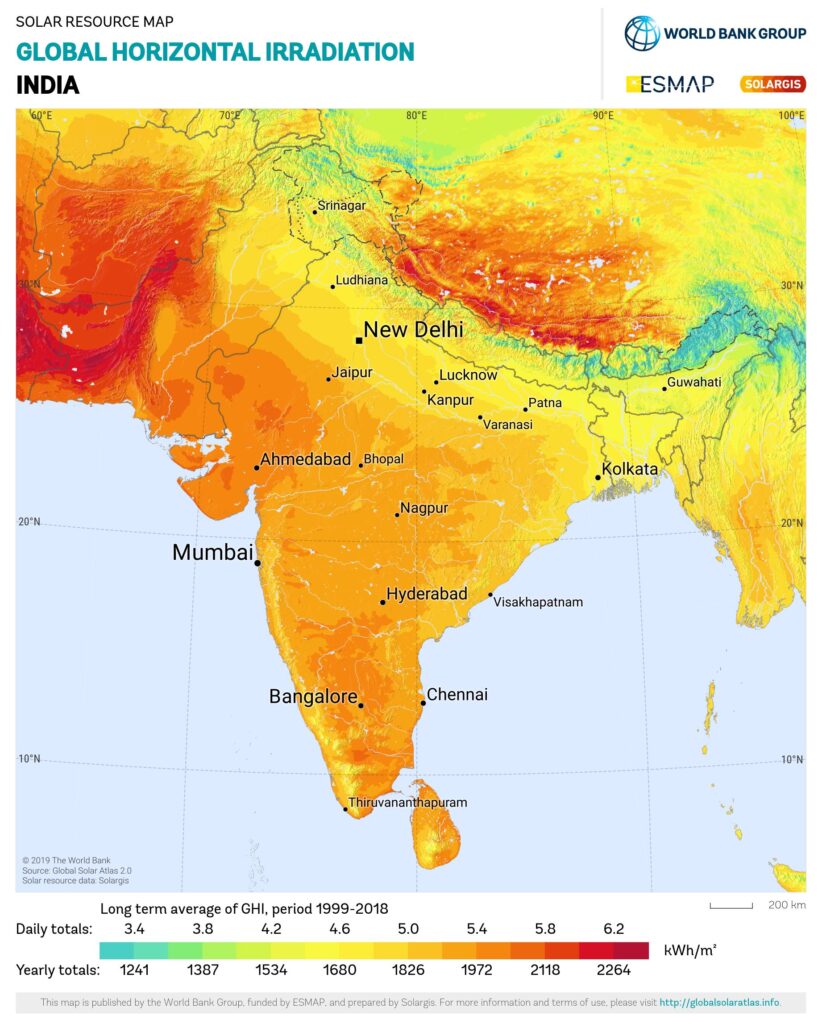
Image courtesy:- Solar resource map © 2021 Solargis.
Solar Radiation Zones in India
India is one of the best countries for solar energy because it receives high solar radiation across most regions.
High Solar Radiation Zones
- Rajasthan desert region
- Gujarat
- Parts of Maharashtra
- Telangana
- Karnataka plateau
Typical values: 5.5 – 6.5 kWh/m²/day
Medium Solar Radiation Zones
- Central India
- Parts of Tamil Nadu
- Madhya Pradesh
- Andhra Pradesh
Typical values: 4.5 – 5.5 kWh/m²/day
Lower Solar Radiation Zones
- North-East India
- Himalayan regions
- High rainfall zones
Typical values: 3.5 – 4.5 kWh/m²/day
FAQ — Solar Radiation in India
What is the difference between beam and diffuse radiation?
Beam radiation comes directly from the sun, while diffuse radiation is scattered by clouds and dust before reaching the ground.
Which radiation value is used for solar panel design?
Global radiation (GHI) is mainly used for solar PV system design.
Which state in India has the highest solar radiation?
Rajasthan and Gujarat have the highest average solar radiation levels.
Can solar panels work with diffuse radiation?
Yes. Solar PV panels can generate power from both beam and diffuse radiation.