
Measurement of solar radiation using pyranometer is an important method used in solar energy and weather monitoring. A pyranometer is a device that measures solar radiation. In simple terms, it tracks how much sunlight energy falls on a surface. It can detect both direct sunlight and the sunlight scattered in the sky. The measurement is usually expressed in watts per square meter (W/m²). Pyranometers are commonly used in solar energy systems, weather stations, and solar research to monitor and analyse solar radiation.
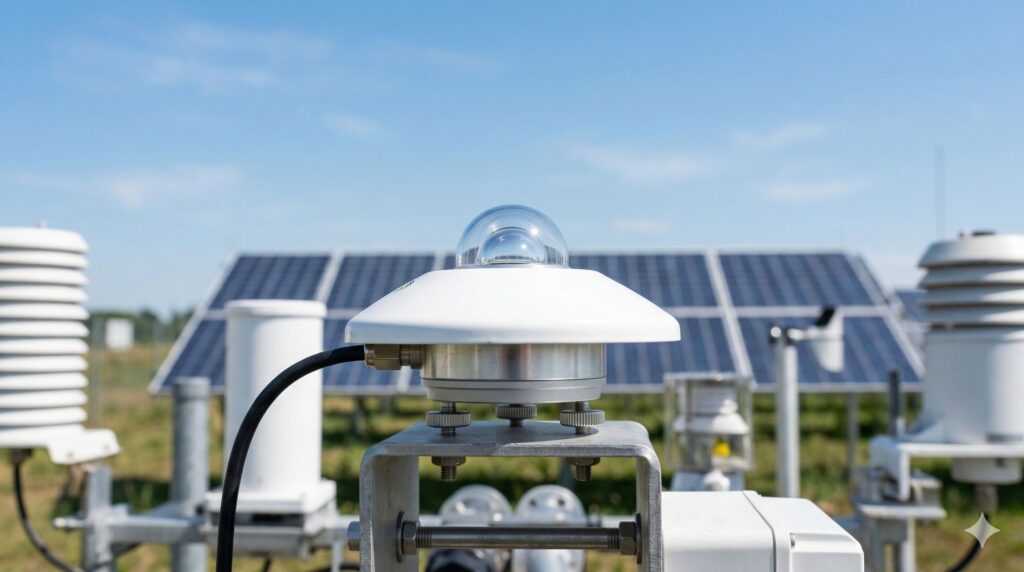
Construction of Pyranometer
A pyranometer has a straightforward design with a few main parts.
- Glass dome: A clear dome on top that allows sunlight to enter while protecting the sensor from dust and rain.
- Black-absorbing surface: A black-coated area that absorbs incoming solar radiation.
- Thermopile sensor: A group of thermocouples that turn temperature differences into a small electrical voltage.
- Body and base: The outer structure that supports all the internal parts.
- Output terminals: Wires that send the electrical signal to a measuring device or data logger.
Working Principle
When sunlight passes through the glass dome, it hits the black-absorbing surface inside the pyranometer. This surface absorbs the solar radiation and gets warm. The reference part of the sensor stays cooler. Because of this temperature difference, the thermopile generates a small electrical voltage. The voltage produced is proportional to the intensity of solar radiation. A data logger or measuring instrument records this voltage and converts it into solar radiation in W/m².
Applications
– Used in weather stations to measure solar radiation
– Used in solar power plants to monitor solar energy
– Used for testing and performance analysis of solar panels
– Used in solar energy research
– Used for environmental and climate studies
How Do You Connect a Pyranometer to Measure Solar Radiation?
A pyranometer is connected to a measuring device to record solar radiation. The instrument is first mounted on a horizontal surface so that it can receive sunlight properly. It must be carefully levelled using the levelling screws and bubble level.
The pyranometer has output wires from the thermopile sensor. These wires are connected to a measuring instrument such as a data logger or microvoltmeter. The device records the small voltage produced by the sensor when sunlight falls on it.
This voltage is proportional to the amount of solar radiation. Using the calibration constant of the pyranometer, the measuring device converts the voltage into solar radiation in watts per square meter (W/m²).