
Phase sequence and polarity are two fundamental ideas in a three-phase electrical system that guarantee the correct operation of electrical equipment, especially motors and transformers. Let’s examine each:
1. Phase Sequence:
Phase sequence is the sequence in which the voltages in a three-phase system reach their peaks. A three-phase system consists of three alternating currents or voltages, each phase-shifted by 120 degrees with respect to the other two. The phase sequence controls three-phase motor rotation direction, proper functioning of other devices, etc.
Types of Phase Sequences:
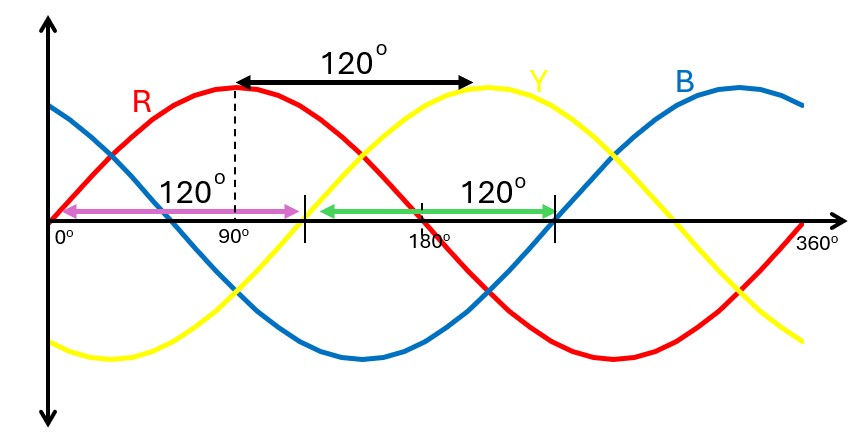
1. Positive Sequence (ABC or R-Y-B):
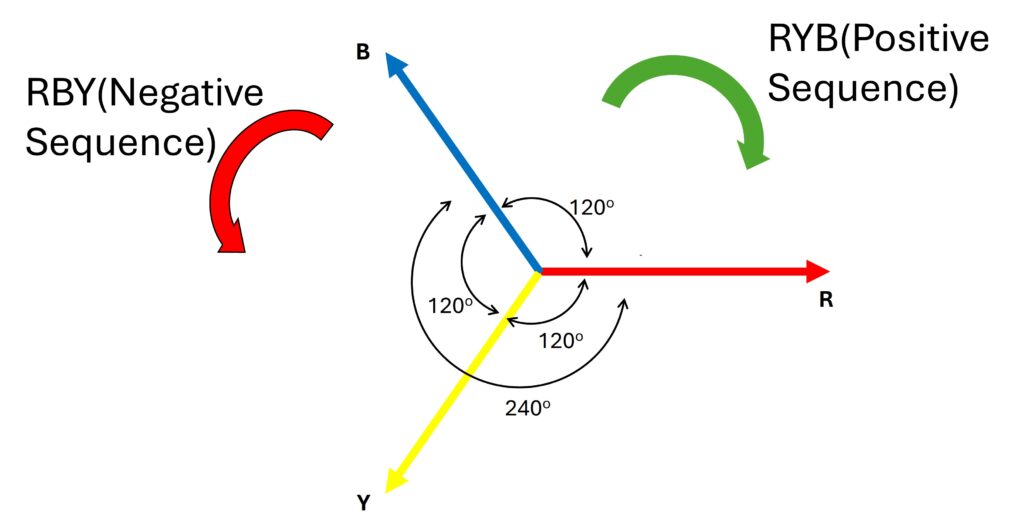
It is a normal sequence. This sequence reaches the maximum of the three-phase voltages, which we can call A, B, and C, or R, Y, and B. Phase R peaks before phase Y, and phase Y peaks before phase B. It can be referred to as the clockwise sequence. Therefore, RYB, YBR, and BRY would be the positive phase sequence. (R-Red, Y-Yellow, B-Blue)
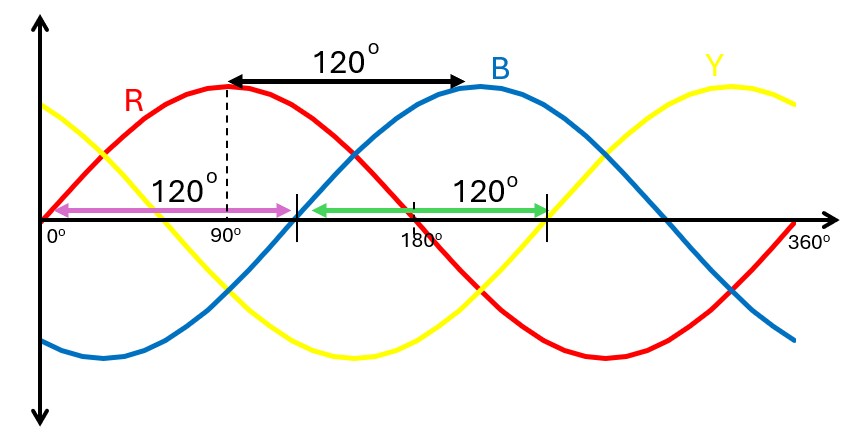
2. Negative Sequence (ACB or R-B-Y):
In this sequence, the order is reversed, so phase R reaches its peak, then phase B, followed by phase Y. RBY, BYR, and YRB, which is the anticlockwise sequence, would be the negative phase sequence.
Why is phase sequence important?
- It decides the direction of rotation of three-phase motors.
- A wrong phase sequence makes the motor rotate in the opposite direction.
- It affects the working of generators, transformers, and three-phase equipment.
How is phase sequence checked?
Using a phase sequence indicator, which may be:
- Rotating disc type
- LED type
- Digital type
2. Polarity:
Polarity in a three-phase system usually refers to the orientation of voltage and current waveforms in relation to a reference point, typically the neutral or ground. In transformers, polarity can refer to the relative direction of windings (e.g., additive or subtractive polarity), which affects how they are connected in systems.
Polarity in Transformers:
Transformers have primary and secondary windings that can be connected in different ways (e.g., star, delta). Correct polarity ensures that the voltages produced on the secondary side are in the correct phase relation to the primary side.
- Subtractive Polarity: When windings are connected such that the secondary voltage subtracts from the primary.
- Additive Polarity: When windings are connected in a way that adds their voltage.
FAQs
What is phase sequence?
It is the order of phases R, Y, and B reaching maximum voltage.
What happens if phase sequence is reversed?
Motor rotates in the opposite direction.
How do we check phase sequence?
Using a phase sequence indicator.
Related Terms: