
A single line diagram (SLD) of an electric power system is a simple drawing that shows how electricity flows from the generating station to the final consumer. Instead of showing all three phases, only one line is drawn, which makes the diagram clean and easy to understand. It is widely used in electrical design and maintenance work.
Single Line Diagram of Power Supply System
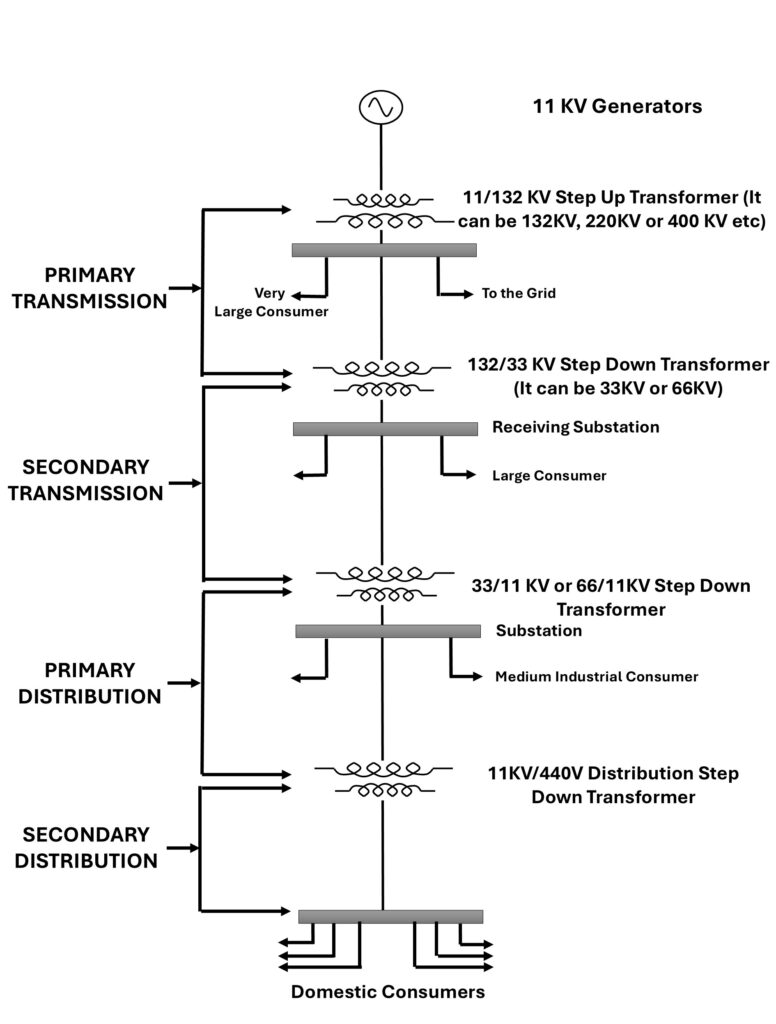
The diagram shows the full journey of electrical power from generation to domestic consumers using a simple one-line representation.
- At the top, an 11 kV generator produces electrical energy. This is the starting point of the system.
- The generated voltage is sent to an 11/132 kV step-up transformer (sometimes stepped up to 220 kV or 400 kV). This higher voltage is used for long-distance transmission to reduce losses.
Primary Transmission Section
- After step-up, power enters the primary transmission network at very high voltage.
- A branch is shown feeding a very large consumer directly (such as a big industrial plant).
- Another branch sends power to the grid for wider network distribution.
Secondary Transmission Section
- Power then reaches a receiving substation.
- A 132/33 kV (or 66 kV) step-down transformer reduces the voltage.
- From here, power is supplied through secondary transmission lines.
- Large consumers can also be connected at this level.
Primary Distribution Section
- Next comes a 33/11 kV or 66/11 kV step-down transformer at a distribution substation.
- Voltage is reduced to 11 kV, which is used for primary distribution.
- Medium industrial consumers are often supplied at this 11 kV level.
Secondary Distribution Section
- Finally, an 11 kV / 415 V distribution transformer steps the voltage down to low voltage.
- This forms the secondary distribution system.
- Output is 415 V three-phase or 230 V single-phase supply.
The low-voltage lines go to the distribution board/bus and then to multiple outgoing feeders. These feeders supply domestic consumers like homes and small shops.