
An inductor is a basic electronic passive component used in electrical and electronic circuits. It is usually made by winding a wire into a coil. When current flows through an inductor, its main job is to store energy in the form of a magnetic field.
Inductors are commonly used to oppose sudden changes in current, filter signals, and control AC in circuits. They are widely found in power supplies, filters, transformers, and electronic devices.
What is Inductor?
An inductor is an electronic component that stores energy in the form of a magnetic field and opposes sudden changes in current when electricity flows through it.
Inductor Symbol
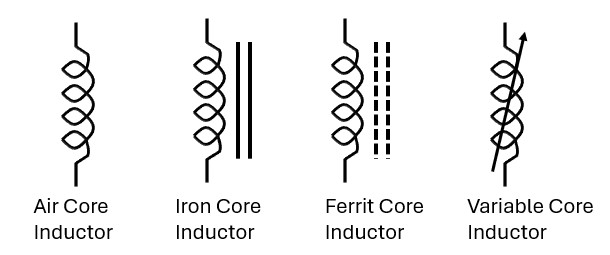
Construction of Inductor
An inductor is constructed by winding an insulated conducting wire into a coil. This coil may be wound on a core or without a core, depending on the application.
The wire used is usually copper because of its low resistance. The core of the inductor can be made of air, iron, or ferrite. The core material helps in increasing the inductance value by strengthening the magnetic field produced around the coil.
The two ends of the coil are connected to terminals. When current flows through the coil, a magnetic field is produced around it. The construction of an inductor mainly depends on:
- Number of turns of the coil
- Type of core material
- Shape and size of the coil
By changing these factors, inductors with different inductance values are made.
Working Principle of Inductor
The working principle of an inductor is based on electromagnetic induction. When electric current flows through the inductor coil, it produces a magnetic field around the coil.
If the current through the coil changes, the magnetic field also changes. This changing magnetic field induces a voltage in the coil that opposes the change in current. This effect is known as self-induction.
Because of this property, an inductor does not allow current to change suddenly and stores energy in the form of a magnetic field.
Inductor in DC Circuit
When an inductor is connected in a DC circuit, it does not allow the current to change suddenly. At the moment the DC supply is switched ON, the inductor strongly opposes the flow of current. It initially acts like an open circuit as a result of this.
As time passes, the current slowly increases and the magnetic field around the inductor becomes steady. Once the current becomes constant, the inductor stops opposing it.
In the steady state of a DC circuit, the inductor behaves like a short circuit and allows DC current to flow freely, with only its small coil resistance affecting the circuit.
- At switch ON → behaves like open circuit
- After steady state → behaves like short circuit
Inductor in AC Circuit
When an inductor is connected in an AC circuit, the current is continuously changing. Due to this changing current, the inductor produces a changing magnetic field, which opposes the change in current all the time.
An inductor allows AC current to flow, but it offers opposition called inductive reactance. The amount of opposition depends on the frequency of the AC supply. At higher frequency, the opposition is more, and at lower frequency, it is less.
In an AC circuit, the current lags behind the voltage by 90 degrees in an ideal inductor. Because of this behaviour, inductors are commonly used in AC circuits for filtering and controlling current.
Energy Stored in Inductor
An inductor stores energy when electric current flows through it. This energy is stored in the form of a magnetic field created around the coil.
When the current through the inductor increases, energy is stored in the magnetic field. If the current decreases, the stored energy is released back into the circuit. This is why an inductor opposes sudden changes in current.
The energy stored in an inductor is given by the formula:
Where:
- E = Energy stored (in joules, J)
- L = Inductance (in henry, H)
- I = Current (in ampere, A)
Proof of Energy Stored in an Inductor
We know that the induced voltage in an inductor is given by:
Work done in an inductor:
When current in an inductor increases by a small amount di, the small work done dW in overcoming the induced voltage is:
Substitute the value of :
Total work done:
To find the total work done in increasing the current from 0 to I, integrate:
This proves that the energy stored in an inductor is equal to ½ L I², and the energy is stored in the magnetic field around the inductor.
Applications of Inductor
- Power supply circuits – used to smooth current and reduce ripple
- Filters – blocks high-frequency signals and allows low-frequency signals
- Choke coils – limits AC current while allowing DC
- Transformers – works on the principle of inductance
- SMPS (Switch Mode Power Supply) – stores and transfers energy efficiently
- Tuning circuits – used in radios and communication systems
- Energy storage – temporarily stores energy in magnetic form
- Noise suppression – reduces electrical interference in circuits